

Journalist Walid Haidar makes his fiction debut with The Tablets of King Shamsmar
Cairo-based Dar Waad for Publishing and Distribution has released The Tablets of King Shamsmar, the debut novel by journalist and author Walid Haidar.
The novel marks Haidar’s latest work and his first venture into fiction, opening a new chapter in his creative writing career. Readers previously came to know him through his non-fiction works, including Journalistic Tales: “Ten Thousand and One Nights in the Court of the Fourth Estate”, and “Aviation Accidents”. With “The Tablets of King Shamsmar”, Haidar turns to literary fiction, exploring new creative horizons.
Set in a richly symbolic imagined world, the novel follows the journey of Shamsmar, who begins as a saviour driven by a vision of justice and freedom, only to evolve gradually into an absolute ruler who reshapes society according to his own convictions. As power becomes an end in itself, the original dream gives way to a system built on ritual, fear and unquestioning obedience.
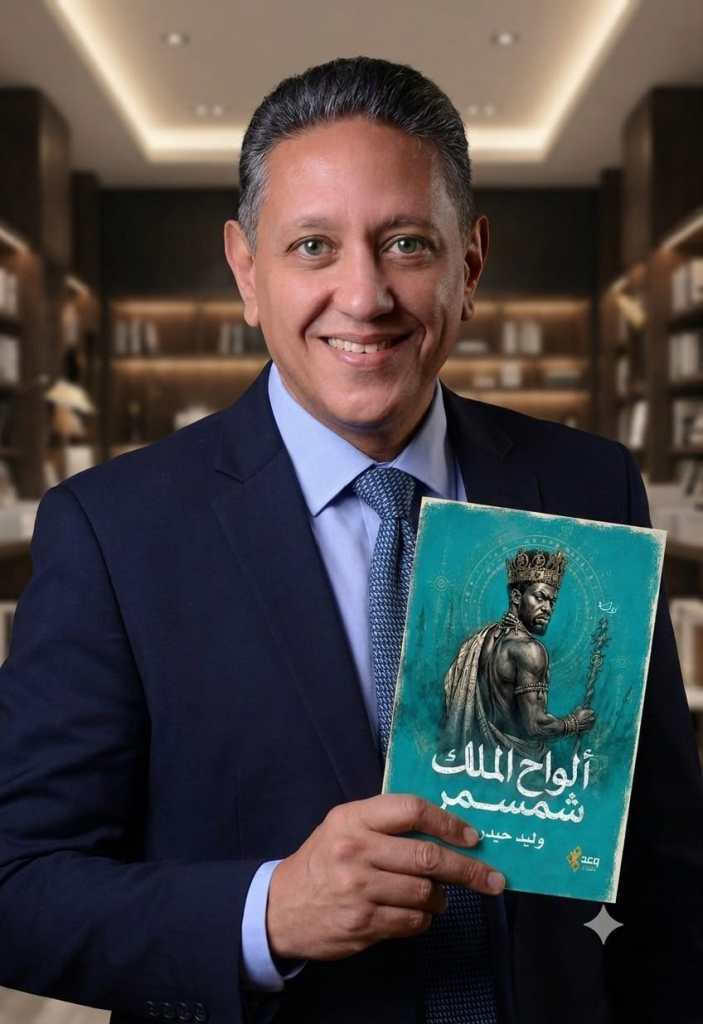
Rather than presenting a conventional struggle between good and evil, “The Tablets of King Shamsmar” is a novel that explores profound philosophical questions about the origins of power, the making of sanctity, and the complex relationship between humanity and authority. It examines how a would-be liberator can ultimately become a tyrant once he believes that he alone possesses the absolute truth.
The novel adopts an unconventional narrative structure, unfolding through a sequence of interconnected tablets that gradually reveal the psychological and intellectual evolution of its characters. Blending epic storytelling with philosophical symbolism, it is written in polished literary Arabic and maintains a steadily intensifying pace that sustains suspense through to its final pages.
Haidar said the novel, which is set around 5,000 years ago, is neither an interpretation of history nor an allegory for any specific period. Instead, it is an attempt to explore a timeless human question: how do illusion and tyranny emerge, and why do people surrender power to those who may ultimately deprive them of their freedom? He said these questions remain relevant across all eras and societies.
Waad Publishing House, which backed the release of the novel, described it as a work driven less by plot than by major philosophical ideas, a relatively rare approach in contemporary Arabic fiction. The publisher said Shamsmar is not a conventional protagonist but a morally complex character whose psychological and philosophical transformation unfolds gradually and convincingly.
The publisher added that dividing the novel into a series of tablets lends it a mythic quality and allows it to be read on multiple levels. Its central concern is not a particular ruler but the mechanisms through which power is created and sustained, giving the work a universal human dimension that transcends time and place.
According to the publisher, the novel is likely to spark critical debate, with some readers approaching it as a philosophical novel and others as a politically symbolic work—one of the hallmarks of fiction that endures in the literary imagination.
Walid Haidar is a journalist, broadcaster and academic who has held senior positions at leading media organisations. He has also lectured at several Egyptian and Arab universities, as well as at media training centres, and spent more than 17 years working in the UAE.
The Tablets of King Shamsmar is available at Leila, Madbouly, Ro’ya, El Waseya and Dar Al Maaref bookstores.


